
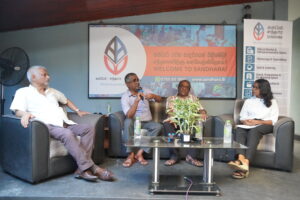
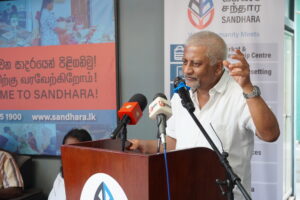
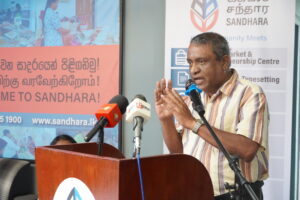
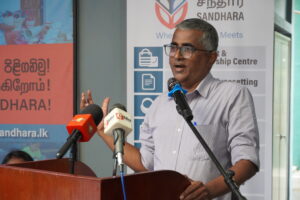
The inaugural dialogue of the Colombo Dialogue Forum, organized by the Right to Life Human Rights Centre, took place on March 13 at 3.30 PM at the Sandhara Dialogue Cafe. The event, organized by the Colombo Human Rights First Aid Centre and moderated by Amandi Hitinayake, explored the theme “Gulf War: Destruction or Change?”. The panel featured Prof. Rohan Samarajiva, Journalist C.J. Amaratunga, and Journalist/Lawyer K.W. Janaranjana.
Economic and Supply Chain Impacts
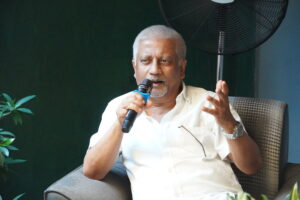
Prof. Rohan Samarajiva focused on how the conflict directly affects Sri Lanka.
- Viewing the war from the outside as if it were a spectator sport is an unkind and flawed perspective.
- Food security and fertilizer supplies are critical concerns.
- Sri Lanka previously experienced a 40-50% drop in crop production and a collapse in the tea industry when attempting to replace NPK fertilizers with organic alternatives.
- This agricultural collapse led to massive losses in export revenue.
- NPK fertilizers are petroleum byproducts primarily transported through the Strait of Hormuz.
- Sri Lanka cannot produce Triple Super Phosphate from the Eppawala deposit due to a lack of sulfuric acid.
- Supply chains will be impacted because most sulfur is transported via the Strait of Hormuz, and chemical fertilizers arrive from China, Qatar, Bahrain, and Jordan.
- Fertilizer prices could rise universally.
- This price increase is compounded by the beginning of the growing season in the Northern Hemisphere, including the US.
- Wheat prices are also susceptible to increases.
- The government has allocated Rs. 36.9 billion for fertilizer subsidies.
- However, further subsidy increases might be restricted by the Public Financial Management Act No. 44 of 2024, which limits government spending relative to GDP.
- The crisis might compel more conservative fertilizer use in Sri Lanka.
- Sri Lanka must become a peaceful, law-abiding, and business-friendly state to capitalize on any emerging opportunities.
- The failure of major connecting airlines could present a development opportunity for the local aviation sector, provided airport infrastructure is improved.
Societal and Ideological Perspectives
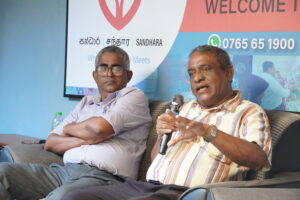
Journalist C.J. Amaratunga analyzed the conflict through a philosophical lens.
- There is a visible collapse in established international law and human rights values.
- The war lacks rationality and is highly destructive to society.
- The conflict represents a clash between established knowledge—like democracy and human rights—and faith-based actions.
- Countries like Iran, Israel, and the US exhibit these ideological characteristics.
- Despite the widespread destruction, the aftermath of this war could present an opportunity to rebuild a better global order.
The Role of International Organizations
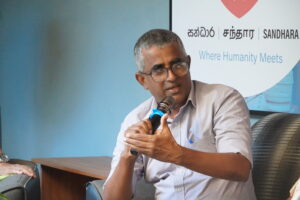
Journalist and Lawyer K.W. Janaranjana discussed the geopolitical framework and the United Nations.
- There is extreme uncertainty surrounding the war’s future trajectory.
- The United Nations, formed in 1945 to prevent such conflicts and protect human rights , has failed to stop the violence despite established international laws.
- A primary reason for this failure is the veto power held by five nations.
- For instance, a UN Security Council resolution demanding Iran to stop attacks had no impact on Israel.
- The UN’s reliance on the United States for 22% of its funding further complicates its efficacy.
- There is a growing consensus that the United Nations requires fundamental reform.
Q&A and Open Discussion Insights
- Sri Lanka relies on LPG rather than LNG, which minimizes direct gas supply impacts from closures in the Strait of Hormuz.
- However, supplies for plastic and textile manufacturing will face disruptions.
- A severe risk exists for the 350,000 Sri Lankan migrant workers in the UAE regarding access to drinking water.
- The UAE relies heavily on desalination plants for its water supply.
- Attacking a desalination plant sets a dangerous precedent.
- In the event of a water crisis, migrant workers would likely be the first to be sent back.
- Self-sufficiency is not a viable alternative for Sri Lanka; the country must build external relationships to mitigate risks.
- The US-led world order established after World War II is actively being dismantled by its own creators.
- The globally integrated economy dictates that a new world order must emerge from this conflict.
- The UN must survive but requires restructuring, specifically regarding veto powers and empowering the General Assembly.
- As a UN member, Sri Lanka has a vote and must actively participate in finding global solutions.
- The United States originally introduced the nuclear program to Iran during the Shah’s regime.
- Sri Lanka should strategically align with India for economic security in the region.
- China and India are remaining neutral to protect and advance their own economic interests.
Here are the specific action items and recommendations highlighted by the speakers and participants during the dialogue:
Economic and Strategic Actions (Prof. Rohan Samarajiva)
- Sri Lanka must become a peaceful, law-abiding, and business-friendly nation to seize any emerging opportunities.
- The country needs to improve its airport infrastructure to potentially capitalize on the aviation opportunities created by the failure of major connecting airlines.
- Sri Lanka must carefully manage fertilizer consumption, as potential price hikes may necessitate more conservative use.
- Pursuing complete economic self-sufficiency is not a viable option or solution for Sri Lanka.
- Instead, Sri Lanka must actively build relationships with other countries to minimize dangers and mitigate risks.
Ideological and Structural Reforms (Journalist C.J. Amaratunga)
- Society must strive to properly understand the nature of the war.
- Outdated international bodies, such as the United Nations, must be renewed to fit the current global context.
- There is a crucial need to build a new world order to replace the current US-led system.
International Policy and Engagement (Journalist/Lawyer K.W. Janaranjana)
- Individuals and nations that value peace and human rights standards must actively seek solutions to the ongoing crisis.
- The United Nations must undergo reorganization and move forward with proposed reforms.
- Reform efforts should focus on addressing the veto power, Security Council membership, and empowering the General Assembly.
- As a member state with a vote in the General Assembly, Sri Lanka must participate in finding solutions to these challenges within the UN framework.
Open Discussion Recommendations

- The citizens of Iran must be the ones to resolve their internal issues regarding their regime, democracy, and human rights.
- To navigate its vulnerable position, Sri Lanka should align itself with India, the dominant economic power in the region.