
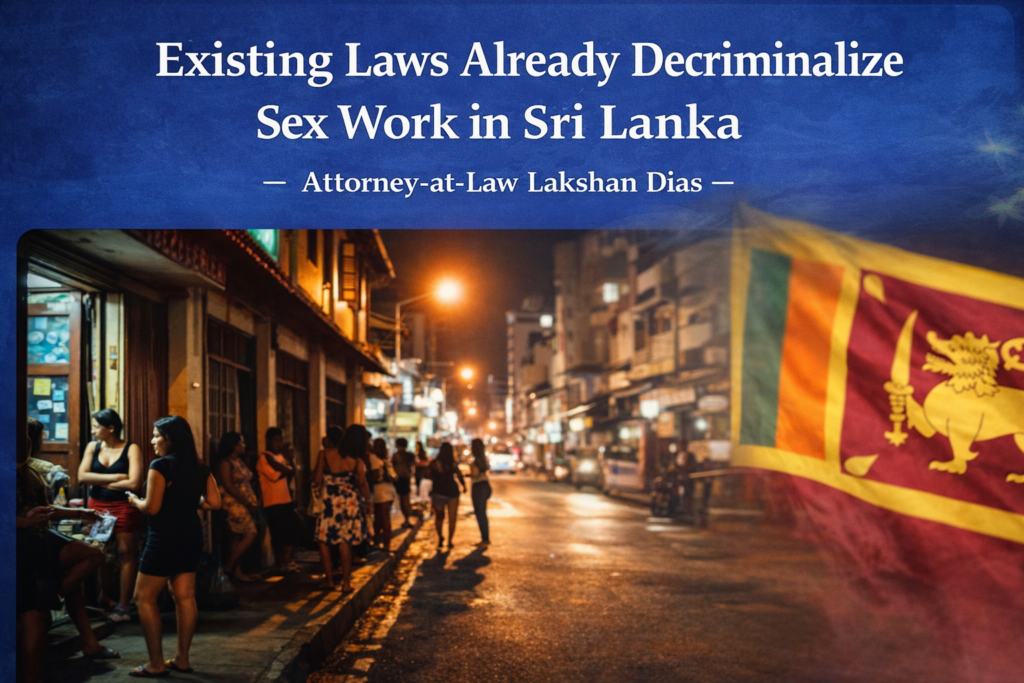
Attorney-at-Law Lakshan Dias has stated that sex work is effectively decriminalised in Sri Lanka under existing judicial interpretations, suggesting that the primary focus should be on recognizing this legal reality rather than drafting complex new legislation.
Providing a comprehensive legal analysis, Mr. Dias noted that the Vagrants Ordinance, introduced in 1841 to control migrant plantation workers, is frequently misapplied today. While Sections 2 and 9 of the Ordinance deal with disorderly conduct and those living off the earnings of prostitution, historical and modern court rulings have clarified that sex workers themselves are not the intended targets of these punitive measures.
“The law penalises making a living out of the corruption and degradation of others, not the individuals engaged in the work for their own survival,” Mr. Dias explained. He highlighted that under Section 9(1)(a) of the Ordinance, as amended in 1919, individuals acting as sex workers to support themselves are considered innocent of an offence.
Furthermore, Mr. Dias highlighted the Prevention of Human Trafficking Act No. 30 of 2005, which reinforces this approach. Under this Act, women and children caught in trafficking are recognized as victims entitled to relief and welfare, rather than individuals subject to criminal prosecution.
Citing the landmark case of Saibo vs. Chellam (58 NLR 25), Mr. Dias pointed out that Justice Jayawardene, drawing on a previous ruling by Chief Justice Abraham in Cooray vs. James Appu, clarified that the law targets “pimps or bullies.” These are defined as individuals who exercise control over another person and live off their earnings through influence or authority.
Mr. Dias further referenced the recent “Gena Madam” case (Rosemary Jude Perera vs. The State), where Justice Buwaneka Aluwihare expanded on these interpretations. In that case, President’s Counsel Rienzie Arsakularatne successfully argued that the mere presence of a service provider—referred to as Priyangika—alongside another person for selection negates the charge of “procurement” under Section 360(a) of the Penal Code, as she was already engaged in the profession.
“Both Chief Justice Abraham and Justice Aluwihare viewed the matter similarly: if a person is personally engaged in the work, Section 9.1 does not apply, unless the individual is under the legal age of consent,” Mr. Dias stated.
The legal expert also noted that the Brothels Ordinance does not hold the women working within such establishments legally liable. Citing the precedent set in Abeykoon vs. Kulatunga, which was recently affirmed in a ruling by former Fort Magistrate Ranga Dissanayake, Mr. Dias reiterated that a woman working in a brothel is not considered an “aider or abettor” to the operation of the establishment.
Beyond the legal framework, Mr. Dias raised profound concerns regarding the social reality of the industry. He questioned whether entering sex work is a genuine “choice” or a tragic fall driven by socio-economic desperation. He highlighted the severe physical and psychological toll on women, who may be forced to serve up to 20 clients daily, a burden rarely shared by male sex workers.
He concluded with a stark reflection on the harsh realities of the trade: “The serious question we must ask is, who among us would make the difficult ‘choice’ to submit their body to an unclean, drunk, and violent man, and agree to fulfil any of his unpleasant demands for money?”
Because the judiciary has already established precedents protecting workers from being criminalised, Mr. Dias argues that the state’s focus should remain on formally accepting this decriminalisation rather than debating new regulatory frameworks.