
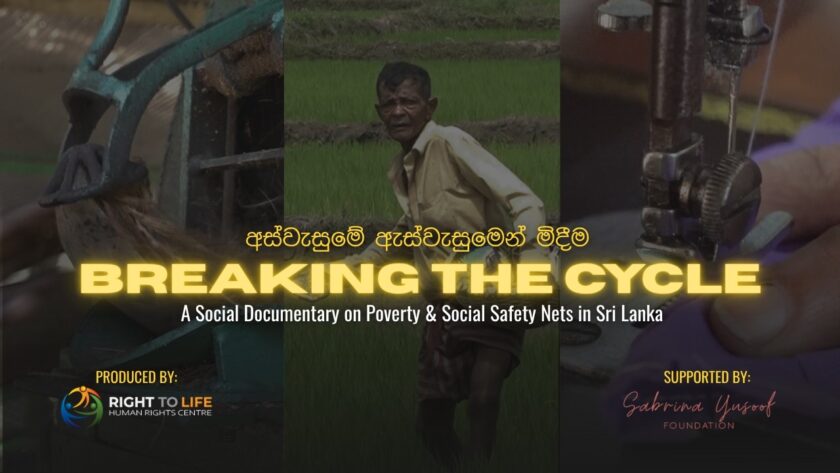
For decades, poverty alleviation in Sri Lanka has been defined by a single word: subsidies. Over the years, programs like Janasaviya, Samurdhi, and the recently introduced Aswesuma have provided relief to millions. However, a profound question remains at the heart of our new documentary video: Are we alleviating poverty, or are we simply sustaining it?
The Right to Life Human Rights Centre invites you to watch our latest video exploration into Sri Lanka’s social safety nets, highlighting the systemic flaws, the voices of the marginalized, and the urgent need to transition from welfare dependency to genuine economic empowerment.
The Reality on the Ground
In 2023, the Right to Life Human Rights Centre conducted a comprehensive baseline survey on social safety nets across 17 districts. The findings, alongside community discussions, revealed a troubling “poverty trap” created by the very systems designed to help.
Systemic Issues Identified in Welfare Programs:
- Stagnant Progress: Over 60% of welfare recipients reported that they had not seen considerable progress in their lives despite receiving aid.
- Welfare Dependency: A dependency mentality discourages people from taking actions to escape poverty.
- Hidden Economies: Some individuals deliberately refrain from economic activities or hide them to ensure they continue receiving welfare benefits.
- Politicization: Welfare selections have historically been driven by political patronage, such as when the number of Samurdhi recipients suddenly surged to 2 million due to politicized selections.
Administrative Hurdles and Targeting Errors
In 2023, the Aswesuma welfare benefits program was launched with World Bank support to assist those impacted by the COVID-19 pandemic and economic crises through temporary cash transfers. While Aswesuma aimed to rectify past errors, it has faced significant challenges.
Grama Niladharis and Samurdhi Development Officers withdrew from the selection census due to strict penalty clauses in the Welfare Benefit Board Act, leading to qualitative data issues.
A 2025 survey indicated that 53% of poor people do not receive Aswesuma benefits. Many complain that richer individuals are selected while the truly needy are rejected.
Our Stance: Empowerment Over Stagnation
The official stance of the Right to Life Human Rights Centre aligns with a fundamental human truth: people must not stagnate in poverty for long periods, as they did during the eras of rice rations and Samurdhi.
Sri Lanka can no longer bear a social security system that entirely depends on subsidies. Poverty alleviation must go beyond mere cash transfers and evolve into a participatory development process that connects communities directly with production.
The Path Forward Requires:
- Targeted Empowerment: Welfare benefits must be provided in parallel with building the livelihoods of the beneficiaries.
- Focus on Entrepreneurship: Low-income families urgently need access to microcredit, training, and market access rather than temporary relief.
- State Protection for the Vulnerable: The state must reserve permanent social security for the segment of society that suffers from chronic poverty, severe illness, or disabilities, while empowering the rest to achieve self-reliance.
- Community Ownership: Programs like the new Praja Shakthi initiative must guarantee transparency to overcome past politicisation and successfully build community ownership.
As one courageous entrepreneur in our video rightly stated, “If we are given a hand, we will lift ourselves.” Watch the full video (with subtitles in English) to hear their stories and learn how Sri Lanka can finally break the cycle of poverty.
Ajith Perakum Jayasinghe