
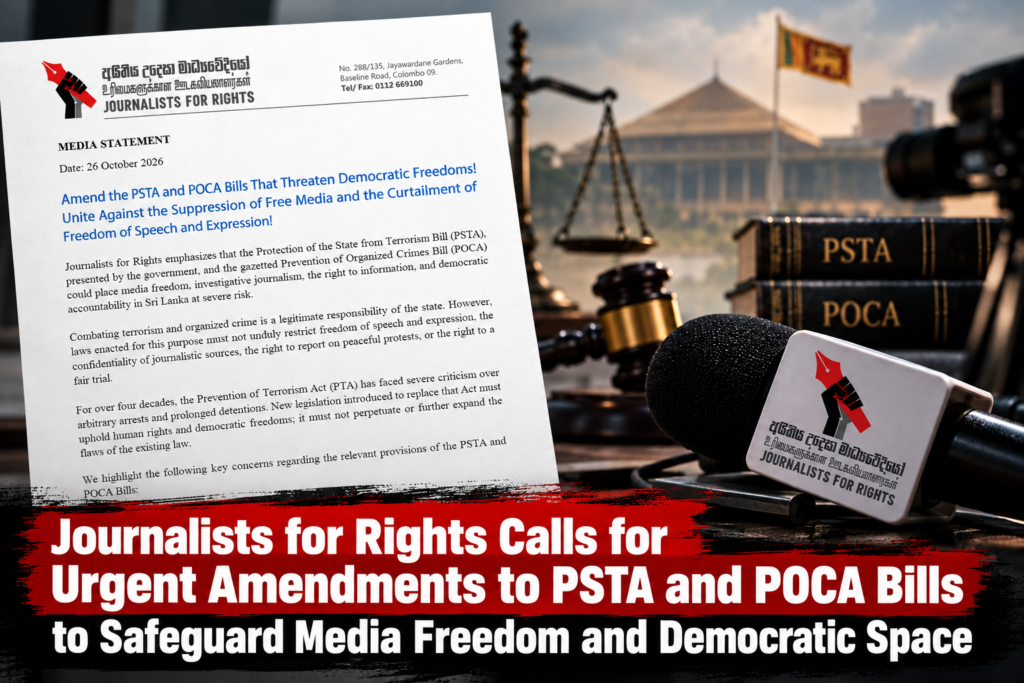
COLOMBO, SRI LANKA | October 26, 2026 —
Journalists for Rights has issued a strong media statement today warning that the government’s proposed Protection of the State from Terrorism Bill (PSTA) and the gazetted Prevention of Organised Crimes Bill (POCA) place media freedom, investigative journalism, the right to information, and democratic accountability in Sri Lanka at severe risk.
While acknowledging that combating terrorism and organized crime is a legitimate state responsibility, the organization emphasized that new legislation introduced to replace the four-decade-old Prevention of Terrorism Act (PTA) must uphold human rights and constitutional freedoms rather than perpetuate or expand existing flaws.
Key Threats to Journalism and Civic Space
In its statement, the Executive Committee of Journalists for Rights highlighted five critical areas of concern within the proposed legislation:
Criminalization of Investigative Reporting and Protest Coverage: The vague and vastly expanded definition of terrorism under Clause 3 of the PSTA Bill—alongside provisions on terrorism-related publications (Clauses 9 and 10)—risks subjecting journalists who expose state corruption and abuse of power in the public interest to criminal prosecution. Furthermore, including offences such as “obstructing a public servant” in the First Schedule of the POCA Bill could allow authorities to invoke special investigative and detention powers against journalists covering peaceful public protests and strikes.
Erosion of Source Confidentiality and Digital Privacy: Mandatory reporting obligations under Clauses 8 and 15 of the PSTA Bill threaten the foundational protection of whistleblowers and journalistic sources. Meanwhile, Clauses 28, 44, and 45 of the POCA Bill grant sweeping powers for the covert interception of communications, acquisition of phone and location data, and compelled access to encrypted digital devices without adequate safeguards or judicial oversight.
Risks to Media Teams Under “Organized Crime” Definitions: Under Clauses 3, 4(2), and 66 of the POCA Bill, organized crime legislation can be applied to offences committed jointly by three or more persons. Without clear legal boundaries—especially when paired with First Schedule offences covering the Online Safety Act (OSA), copyright and intellectual property, and protest activities—a news editor, reporter, and camera operator working on an assignment, or social media activists publishing jointly, could face unwarranted prosecution as an “organized criminal group.”
Restrictions on Field Reporting and Court Coverage: Broad powers under the PSTA to search, arrest, seize reporting equipment (such as cameras, phones, and computers), and declare “prohibited places” (Clause 61) threaten frontline reporting on human rights violations. Additionally, restrictions on publishing information regarding judicial proceedings under Clause 14 of the POCA Bill risk curtailing the public’s legitimate right to know.
Undermining Judicial Oversight and Fair Trial Rights: Provisions in the PSTA and Clauses 20–25 of the POCA Bill vesting executive officials with detention powers and restricting magistrates’ bail discretion threaten judicial independence and personal liberty. The organization also raised serious alarm over Clause 47 of the POCA Bill, which renders confessions made to an Assistant Superintendent of Police (ASP) or higher-ranking officer admissible as evidence, heightening the risk of coerced statements, while corporate liability clauses risk driving media institutions toward self-censorship.
Five Key Demands to the Government
Standing in defense of Sri Lanka’s shrinking civic and democratic space, Journalists for Rights urged the government to take immediate corrective action:
Withdraw or amend provisions in both the PSTA and POCA Bills that unduly restrict freedom of expression, personal liberty, fair trial rights, and the right to information.
Protect journalistic sources and digital privacy by introducing strict judicial oversight and legal safeguards to POCA Clauses 28, 44, and 45, and reconsidering PSTA Clauses 8 and 15.
Safeguard media teams, trade unions, and civil society from being treated as organized criminal groups by amending POCA Clauses 3, 4(2), and 66, and removing OSA, copyright, and peaceful protest-related offences from the POCA First Schedule.
Uphold judicial independence and fair trial standards by reviewing executive detention orders, protecting magisterial discretion over bail, and amending POCA Clause 47 regarding police confessions and media management liability.
Implement democratic media reforms, including the full repeal of the PTA and meaningful consultations with media organizations, trade unions, legal scholars, and civil society when reviewing laws affecting fundamental rights, such as the Online Safety Act (OSA).
“Protecting media freedom is not merely about protecting the professional rights of journalists; it is about safeguarding the people’s right to know, public scrutiny of state power, and democratic accountability,” the statement concluded, calling on all citizens and civic actors to unite in defending free media and the rule of law.
Read the Full Media Statement by Journalists for Rights Here
MEDIA STATEMENT – Journalist For Rights