
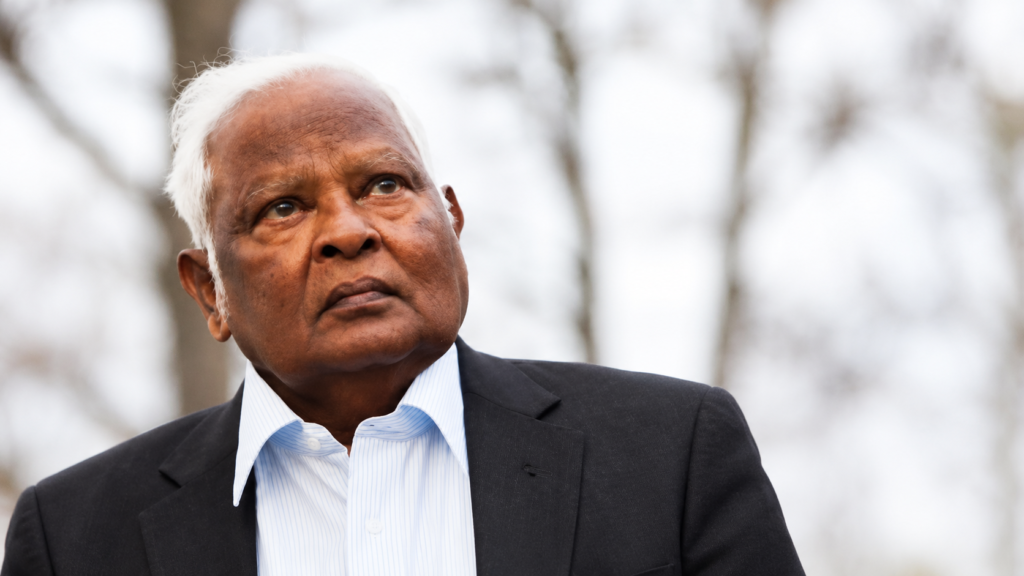
This reflection is written by Sanjeewa Liyanage, who shared a close friendship with Basil Fernando for nearly four decades and worked closely with him for many years. It also carries the memories, affection and respect of many colleagues who worked with Basil at the Asian Human Rights Commission and the Asian Legal Resource Centre.
It is not easy to find words to write about Basil Fernando, whom we affectionately called “Basil Uncle.” For nearly four decades, he was part of my life. He was a close friend, a senior and experienced colleague, a mentor and, in many ways, someone like a father to me.
As I write about his passing, my heart is heavy with sadness. Yet alongside that grief are love, respect and a profound sense of gratitude for all that I learned from him. My memories of Basil are not simply memories of one person. They are also memories of a long journey that began during one of the darkest periods in Sri Lanka and continued across Asia in the pursuit of human rights and justice.
We both came from Hendala. Before I left Sri Lanka in 1988, I lived in Palliyawatta, in a house between Basil’s home and the local church. The Hamilton Canal, the Kelani River and the Palliyawatta beach were familiar parts of our lives. But not all the memories associated with those places were pleasant ones.
At that time, young people were disappearing. Parents moved helplessly from place to place searching for their children. As a lawyer, Basil Fernando worked tirelessly to try to save those young lives. He stood with families whose children had been abducted and sought the protection of the courts on their behalf. In those days, doing so meant putting his own life at risk. Eventually, he too was forced to leave the country within a matter of hours.
Our friendship truly began in 1989, when he arrived in Hong Kong. Because of the backgrounds we came from and what we had both witnessed, we did not need many words to understand one another. We both carried a deep sense of pain and anger about what was happening in our country, together with a strong conviction that things had to change.
What we had experienced was not simply news of death. We had lived through dark days in which the cruel smell of death had entered our consciousness so deeply that even today the memory can still disturb us.
Basil was constantly thinking about what could be done so that others would not have to suffer in the same way. At a time when there was very little that could safely be done from inside the country, we did everything we could, even from a distance, to draw the attention of the world to what was happening.
I will never forget the twelve years I spent working closely with him and with our colleagues at the Asian Human Rights Commission. We spent long days and late nights drafting urgent appeals, statements and articles, discussing the cases of people who were suffering, and arguing over ideas.
Of all those memories, one of the strongest is Basil’s deep sense that help should never be delayed.
“Act now. Not this afternoon. Not tomorrow.”
He pushed us with such urgency for a reason. At that very moment, someone might have been undergoing torture in a police station. Someone else might have been suffering in a remand prison. Our delay could mean prolonging their suffering.
Who that person was did not matter to him. It was enough that they were human. Every life was a life of equal value.
His body received very little rest. I do not know whether his mind ever truly rested.
There was one question Basil Fernando asked again and again:
Why?
Why do human beings become so cruel to one another? Why does a society become accustomed to witnessing cruelty and begin to accept it as normal? Why do we remain silent when terrible things are happening around us? Why do we sometimes fail even to recognise that treating another person as inferior is wrong?
We spent hours talking about our country. Those conversations were often not simply about politics. We spoke about our people, history, culture, relationships and the way we think.
Basil wanted to understand what lay beneath what was visible. He questioned not only violence itself, but also the attitudes, habits of thought and patterns of behaviour that allowed violence to emerge and to continue.
He spoke often about the way some people are treated as superior and others as inferior because of caste, wealth or birth. He believed that we had to look honestly at how deeply such divisions had entered our lives. These were not easy issues to discuss. But precisely because they were uncomfortable, he refused to avoid them.
One of the most important lessons I learned from him was that loving one’s culture, language, religion or country does not mean accepting everything done in their name without question.
Does a tradition we proudly preserve cause suffering to another person? Does something we consider noble or superior lead us to treat another human being as lesser? Basil insisted that such questions had to be asked.
Behind every such question, for him, stood a human being: someone who had suffered, someone who had been humiliated, someone silenced by fear, someone taught to believe that their life was worth less than the lives of others. His mind always returned to that person.
He taught us that if we truly love our society, we must have the courage to see what is wrong with it. Change must begin within ourselves. We must examine the way we think and the way we treat others. We must learn to treat every human being with the same dignity and compassion.
Many of these questions return in his final work, Quality of Justice and the Question of Social Mobility. While he was working on the final version, Basil told me that he regarded it as the most important book he had written. It was published in Sri Lanka only a few weeks before his death. I am grateful that he lived to see it.
One powerful idea from that book remains with me in very simple terms.
No one should grow up believing that, because of where they were born, their family, caste or poverty, they are somehow worth less than others.
And yet generations of injustice can teach people to believe that humiliation, fear and silence are simply part of what life has allotted to them. Basil wanted to break that belief. He wanted people to ask questions. Above all, he wanted them to recognise their own worth.
Even during his final months, weeks and days, Basil never really stopped working. I was fortunate to remain in contact with him and to speak with him several times, including while he was in hospital.
Even then, he remained impatient. There was still work to be done. There were still things to say. There was still more to write, more to question.
But today, among all these memories, what comes closest to my heart is the deeply compassionate human being within him.
The lawyer, the writer and the human rights advocate was also one of the kindest and humblest people I have known. There were times when he was deeply disappointed in life. Grave injustices were also done to him. Yet I never saw in him a desire for revenge.
He had an extraordinary capacity to forgive.
That was one of the great personal lessons I learned from him. We do not have to carry resentment, anger and hurt as burdens throughout our lives. We can also learn to let them go.
Though Basil spent years fighting cruelty, he never allowed his own heart to become cruel. He did not bend in the face of injustice, but his heart remained full of compassion for people. For me, that was one of the most beautiful things about his life.
When I think of him today, I remember our long conversations and debates, and the long days and nights we worked together. I remember his unwavering positions and the anger he felt when he saw injustice. But I also remember his humour and his laughter.
Those of us who worked with him remain deeply grateful for what he taught us about human dignity, compassion and forgiveness. He taught me that something does not become right simply because it is familiar to us, and that we must never be afraid to question it.
Above all, he reminded us of something very simple: human rights begin with the human being in front of us. They begin with recognising that person’s dignity. They begin with accepting that the other person, like us, feels pain and joy and needs love, safety and protection.
I extend my deepest condolences to all members of his family, especially Aunty Jacinta, Jessica, Namal and Asanga. I share your grief at this painful time.
We have lost a deeply precious human being. We will feel his absence profoundly. And yet I do not feel that he has completely left us.
His ideas remain with us. The questions he asked remain with us. His words remain with us. And above all, the love, care and compassion he gave us remain within our lives.
I remember the thinker. I remember the writer. I remember the man who stood fearlessly for the rights of others.
But more than all of that, what remains most strongly in my memory is his compassionate heart. His humility. His ability to forgive. His courage to ask difficult questions. His unwavering belief that every human being has equal worth.
Farewell, Basil Uncle.
Thank you for living a life filled with meaning, and for sharing that life so generously and lovingly with all of us.
May the love you gave us remain among us.
May the path you showed continue to bring light to other lives.
May you rest in eternal peace.
Sanjeewa Liyanage
About the Author
Sanjeewa Liyanage has worked in the fields of human rights, law and justice for more than three decades. He spent twelve years with the Hong Kong-based Asian Human Rights Commission (AHRC) and the Asian Legal Resource Centre (ALRC), where he worked closely with Basil Fernando. Since 2006, he has served as International Program Director of International Bridges to Justice (IBJ), a Geneva-based organisation working to strengthen access to justice. His work has focused particularly on criminal legal aid, early access to legal counsel following arrest, the prevention of torture, the protection of fair trial rights, and strengthening justice systems in countries across Asia, Africa and other regions.