
30 October 2026 | Colombo, Sri Lanka
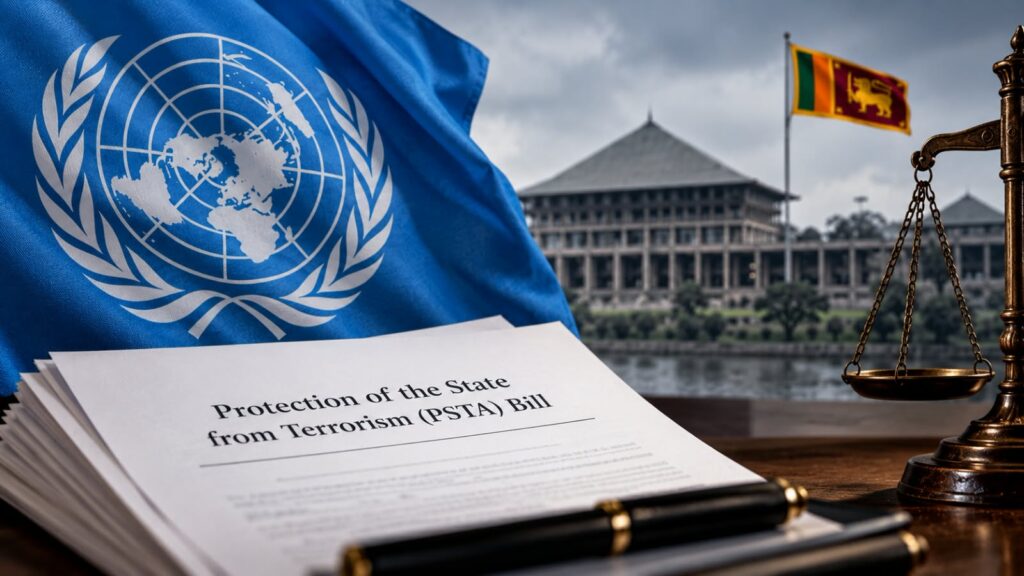
The United Nations Office of the High Commissioner for Human Rights (OHCHR) has outlined nine key recommendations concerning Sri Lanka’s proposed Protection of the State from Terrorism (PSTA) Bill, calling for stronger safeguards to ensure compliance with international human rights standards.
In its legal assessment issued in October 2026, OHCHR acknowledged certain improvements in the proposed legislation while raising concerns about provisions relating to arbitrary detention, judicial oversight, torture prevention and fundamental freedoms.
Nine Key Recommendations
The UN Human Rights Office highlighted the following areas requiring attention:
1. Narrow the definition of terrorism: Ensure that terrorism-related offences are clearly defined and do not criminalise legitimate expression, peaceful protest or civic activities.
2. Strengthen judicial oversight: Guarantee prompt and effective judicial supervision of arrests and detention.
3. Prevent torture and arbitrary detention: Introduce stronger legal safeguards against torture, ill-treatment, arbitrary detention and enforced disappearance.
4. Protect fair-trial rights: Ensure due process, access to legal representation and fundamental fair-trial guarantees.
5. Require judicial authorisation: Strengthen judicial control over searches, entry into premises and seizure of property.
6. Maintain civilian law-enforcement authority: Ensure that civilian police retain primary responsibility for law enforcement, with military involvement appropriately restricted.
7. Strengthen independent accountability: Establish effective independent oversight mechanisms and remedies for human rights violations.
8. Limit immunity provisions: Ensure that legal immunity does not prevent accountability for serious human rights violations.
9. Ensure meaningful public consultation: Engage civil society, legal professionals, independent institutions and affected communities in the legislative process.
Concerns Over Detention and Fundamental Rights
OHCHR expressed particular concern about provisions granting extensive executive detention powers and emphasised the importance of independent judicial supervision.
The assessment also highlighted the potential implications of broadly defined terrorism-related offences for journalists, human rights defenders, civil society organisations and individuals exercising their rights to freedom of expression, peaceful assembly and association.
OHCHR further emphasised that replacing the existing Prevention of Terrorism Act (PTA) should represent meaningful legislative reform, supported by effective safeguards against arbitrary detention and other human rights violations.
The UN Human Rights Office called for a comprehensive and inclusive review of the proposed legislation to ensure that Sri Lanka’s counter-terrorism framework meets international human rights obligations while addressing legitimate national security concerns.
Source: OHCHR – Comments on Sri Lanka’s Protection of the State from Terrorism (PSTA) Bill, October 2026.
https://srilankabrief.org/wp-content/uploads/2026/10/ohchr-comments-pstabill-14-10-26.pdf?utm