
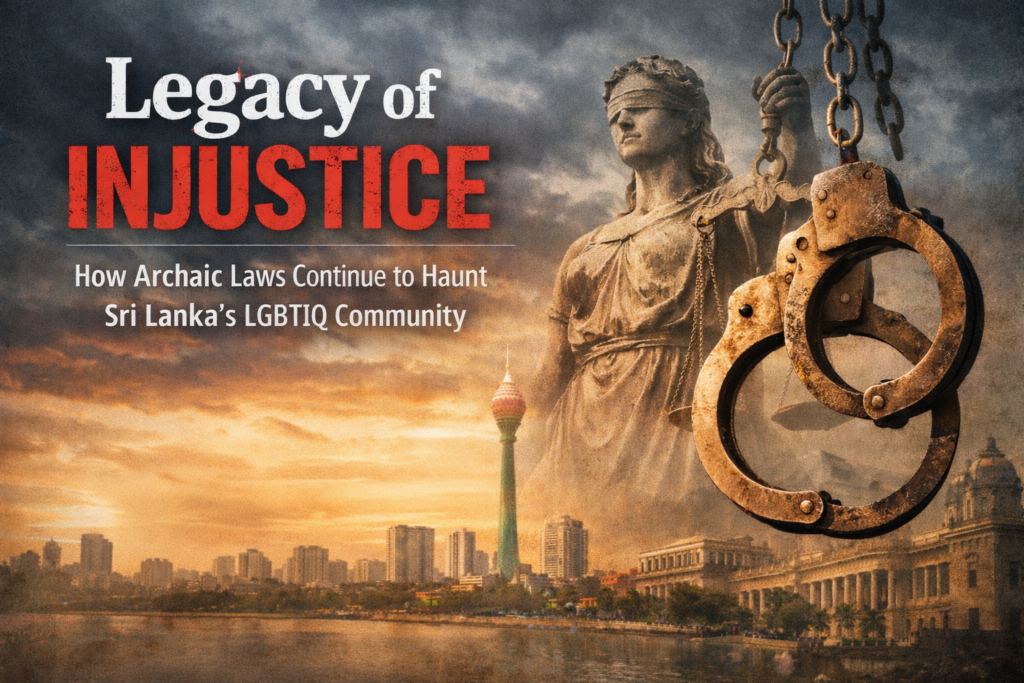
Sri Lanka’s legal landscape regarding the LGBTIQ community remains a complex web of colonial-era statutes and modern interpretations. While the constitution guarantees equality, a specific set of “archaic” laws relics of the British Victorian era are frequently weaponized to marginalize, harass, and prosecute individuals based on their sexual orientation and gender identity.
Below is an analysis of these laws, their misuse, and the legislative attempts to dismantle them.
- The “Unnatural” Offences: Penal Code Sections 365 & 365A
These two sections are the primary tools used to criminalize same-sex intimacy. Both were introduced in 1883 by the British colonial administration.
- Section 365 (“Unnatural Offences”): This law criminalizes “carnal intercourse against the order of nature.” While originally drafted to penalize sodomy, the vague phrasing “against the order of nature” has allowed law enforcement to interpret it broadly.
- Section 365A (“Acts of Gross Indecency”): Added later to broaden the scope, this section criminalizes “acts of gross indecency between persons” in public or private.
The Misuse: Though convictions under these sections are rare, they are frequently used as tools of intimidation. Police often use the mere threat of these laws to:
- Justify arbitrary arrests and detention of LGBTIQ individuals.
- Subject individuals to intrusive and degrading medical examinations (such as forced anal/vaginal exams) to “prove” sexual activity.
- Extort bribes or sexual favors from victims who fear public outing or imprisonment.
- Raid private spaces or hotels where same-sex couples are staying, violating their right to privacy.
- The “Impersonation” Trap: Penal Code Section 399
Section 399 defines the offense of “Cheating by Personation.” It is intended to stop fraud for example, someone pretending to be a specific official to steal money.
The Misuse against Transgender Communities: This law is maliciously misapplied to target transgender women. Police frequently allege that a transgender woman dressing in female attire is “impersonating” a woman to “cheat” the public.
- Criminalizing Identity: By treating gender expression (clothing, makeup) as a form of “disguise,” law enforcement effectively criminalizes the daily existence of transgender people.
- Documentation Gaps: If a trans person’s National Identity Card (NIC) still lists their sex assigned at birth, police use this discrepancy as “proof” of impersonation under Section 399, ignoring the person’s lived gender identity.
- The “Vagrancy” Loophole: The Vagrants Ordinance of 1841
Perhaps the most actively used archaic law is the Vagrants Ordinance, specifically vague sections related to “idling” and “indecency.”
- The Law: This 19th-century law was designed to clear the streets of the poor and “undesirables” in colonial Ceylon. It criminalizes behaving in a “riotous or disorderly manner” or being found in public spaces without a “satisfactory account” of oneself.
- The Misuse: Police routinely use this ordinance to arrest LGBTIQ individuals, particularly transgender women and sex workers, who are simply walking or standing in public spaces.
- “Idling” Charges: Transgender women are often arrested for “loitering” or “idling,” with police assuming they are soliciting sex solely based on their appearance.
- Detention Centers: Unlike standard prison sentences, convictions under this ordinance can lead to indefinite detention in state-run “rehabilitation” centers, where detainees often face further abuse.
The Path to Reform: MP Premnath C. Dolawatte’s Private Member’s Bill
In a significant move toward reform, SLPP Member of Parliament Premnath C. Dolawatte submitted a Private Member’s Bill to Parliament aimed at amending the Penal Code.
- The Proposal: The bill seeks to amend Sections 365 and 365A to decriminalize consensual same-sex sexual acts between adults. It does not legalize same-sex marriage but removes the criminal element of same-sex intimacy.
- Supreme Court Determination: In a landmark decision in May 2023, the Supreme Court of Sri Lanka ruled that the bill was consistent with the Constitution. The Court acknowledged that the current laws are archaic and that LGBTIQ citizens are entitled to dignity and privacy. This ruling effectively removed the major legal hurdle for decriminalization.
- Current Status: despite the Supreme Court’s green light and support from various political factions (including the NPP’s manifesto pledges), the bill has faced delays in the legislative process. It requires a parliamentary vote to become law.
Recommendations for the Present Government
The current administration has a unique opportunity to align Sri Lanka’s laws with modern human rights standards and its own constitutional guarantees.
- Enact the Dolawatte Amendment (or a Government Equivalent): The groundwork has already been done. The government should expedite the passing of the amendment to Sections 365 and 365A. Decriminalization is the baseline for ensuring the safety of the community.
- Issue Police Circulars on Section 399 & Vagrants Ordinance: While legislative repeal takes time, the Ministry of Public Security can immediately issue a circular instructing police that:
- Section 399 applies only to fraudulent intent (e.g., financial fraud) and cannot be used to penalize gender expression or clothing choices.
- The Vagrants Ordinance should not be used to target individuals based on appearance or gender identity.
- Comprehensive Repeal of the Vagrants Ordinance: This law is obsolete and disproportionately affects the poor, women, and the LGBTIQ community. It should be repealed and replaced with modern public nuisance laws that do not criminalize status or poverty.
- Constitutional Recognition: The government should consider explicit inclusion of “Sexual Orientation and Gender Identity” (SOGI) as protected characteristics under Article 12 (Right to Equality) of the Constitution during any future constitutional reform process, preventing these archaic laws from ever being weaponized again.