
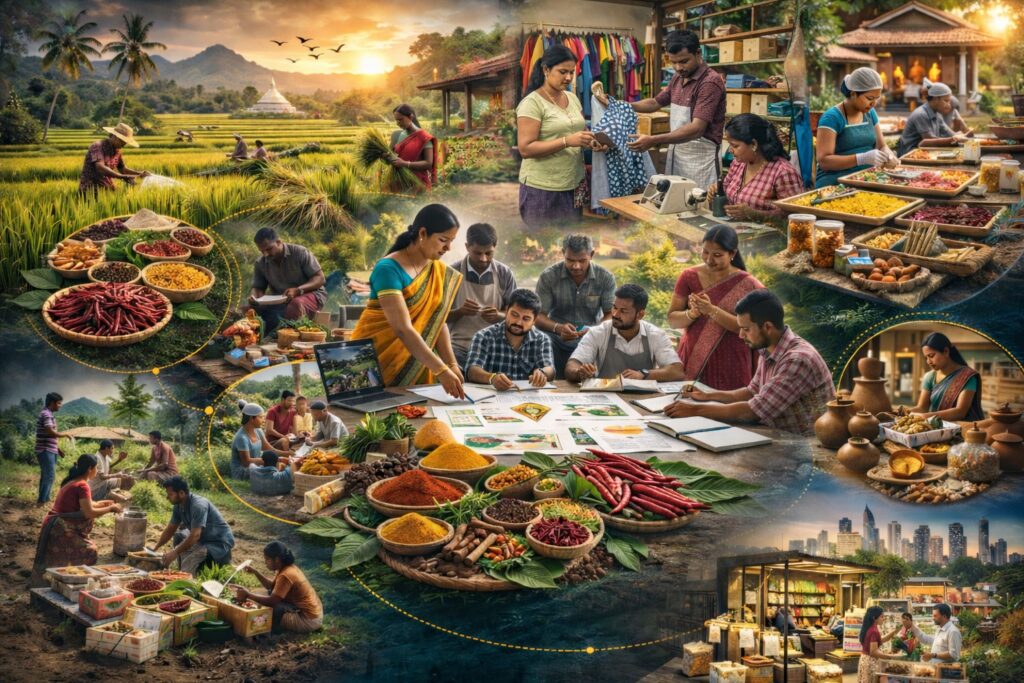
Mapping the Ground: Discovering Entrepreneurial Potential in Human Rights Communities
Having a bold vision for a “hybrid model” of business and justice is one thing; deciding exactly what to produce and sell is another. As we shifted our mindset from asking “Who will fund us?” to “How can we fund ourselves?”, we knew one thing for certain: we could not design these social enterprises from a desk in Colombo.
If these ventures were to sustain our Human Rights First Aid Centres (HRFACs), they had to be rooted in the realities of the communities they serve. To bridge this gap, we launched Participatory Opportunity Mapping workshops across our pilot districts, ensuring that the enterprise ideas were owned by the community, utilised local resources, and addressed actual unmet needs.
The Methodology: “A Bird in Hand” and “Bricolage”
When our Human Rights and Social Enterprise Development Centres gathered grassroots defenders, micro-entrepreneurs and small-scale business people, we didn’t start by asking what they lacked. Instead, we focused on what they already had.
We introduced practical entrepreneurial frameworks during the training sessions. Participants engaged in the “Bird-in-Hand” exploration, identifying immediate natural, cultural, and human assets available to them. We also taught the concept of “Bricolage”—the creation or arrangement of something using whatever materials or sources are available at the time. This approach empowered communities to transform local “pain points” into attractive, fundable opportunities.
Rising from the Wreckage: Economics as Disaster Resilience
These mapping exercises did not happen in a vacuum. The devastating impact of the recent Ditwa Cyclone heavily influenced the workshops.
The cyclone laid bare the vulnerabilities of informal workers and small-scale entrepreneurs. In response, we introduced the “RRR” concept: Response, Reduce, and Rehabilitation. We realised that economic survival is a core component of disaster resilience. Demonstrating this immediate link, the Kegalle HRSEDC integrated an emergency relief initiative into the project, awarding a recovery grant of LKR 10,000 to 15 affected small entrepreneurs to swiftly procure raw materials and re-establish their businesses.
The Intersection of Rights and Commerce
How does human rights advocacy fit into selling local products? During the workshops, we demonstrated how legal tools could protect community enterprises. For example, participants were mentored on using the Right to Information (RTI) Act to ensure transparency in local governance and shield their businesses from corruption.
We also confronted the systemic barriers that marginalised groups face. In Badulla, participants discussed the case of a local laddu producer who was denied business registration due to estate-related issues. This stark reality underscored a crucial project philosophy: human rights advocacy must accompany economic development, as marginalised entrepreneurs cannot succeed if systemic discrimination blocks their path to formal commerce.
A Wealth of Grassroots Innovation
The participatory group work generated a remarkable diversity of locally feasible business proposals across the districts:
- Agricultural & Traditional Foods: Anuradhapura prioritised the cultivation and marketing of traditional organic rice, aiming to improve soil health and secure premium prices for smallholder farmers. Monaragala proposed ‘Uva Kurahan’, utilising new technology to elevate traditional finger millet into a globally recognised brand, alongside ‘Induwara Sweet Tamarind’ health products. In Puttalam, the community focused on establishing a central plant nursery that will expand to 20 beneficiary families, supporting national distribution and export markets. In Badulla, entrepreneurs proposed greenhouse and green tunnel cultivation for flowers, bell peppers, and gherkins, alongside ‘Rainbow Protect’, an integrated farming model combining livestock, poultry, and biogas. Nuwara Eliya focused on organic farming targeted at school meals and expanding local dairy production to include ghee, cheese, and paneer.Value Addition & Preservation: To combat post-harvest waste, communities in Anuradhapura, Badulla, and Puttalam identified the processing of dehydrated fruits and vegetables as a sustainable livelihood. Kegalle prioritised dedicated spice processing and Kithul value addition. The focus on local branding was strong: Badulla pitched ‘Green Fire’ for ghost pepper-based exports and ‘Ayubala Nelli Drink’, while Monaragala introduced ‘Kapruka Coco Products’ for coconut-based items and ‘UVA Eco Food’. Nuwara Eliya participants highlighted ‘Vishwa Honey’ production and the marketing of their regional tea powder, ‘Niyama Kahata’. Puttalam also outlined plans for processing dried spices and blended seasonings.
Eco-Friendly Crafts & Cosmetics: Moving toward a plastic-free economy, Kegalle groups proposed clay products and eco-friendly packaging. Anuradhapura highlighted handmade Pan and wooden crafts, while also proposing herbal-based shampoos and body lotions utilising local medicinal leaves and flowers. Badulla groups showcased unique innovations, including foundation powder made from rosewood, natural lacquer derived from tree gum, and ‘A.J. Natural’ food-grade paper products. Nuwara Eliya participants suggested repurposing banana leaves as sustainable products for cultural events and developing cosmetic products using locally grown avocados
Confronting the Reality: The Hurdles Ahead
While the innovation was inspiring, the communities were realistic about the hurdles ahead. During the mappings, participants identified significant challenges, including limited access to startup capital, gaps in technical knowledge and quality control, and inadequate infrastructure for storage and transportation.
From Blueprints to Reality
The Participatory Opportunity Mapping workshops successfully transformed abstract concepts of social enterprise into concrete, community-endorsed business proposals. We now have a blueprint built not from top-down assumptions, but from the ground up.
As the Vriddi project moves forward, these prioritised opportunities will enter the incubation phase, where we will tackle the identified hurdles through technical training and mentoring. Ultimately, the goal is to connect these grassroots producers with urban consumers through our Sandhara ethical retail and exhibition hub in Colombo, turning local resilience into a sustainable social enterprise that leverage the movement for justice.