
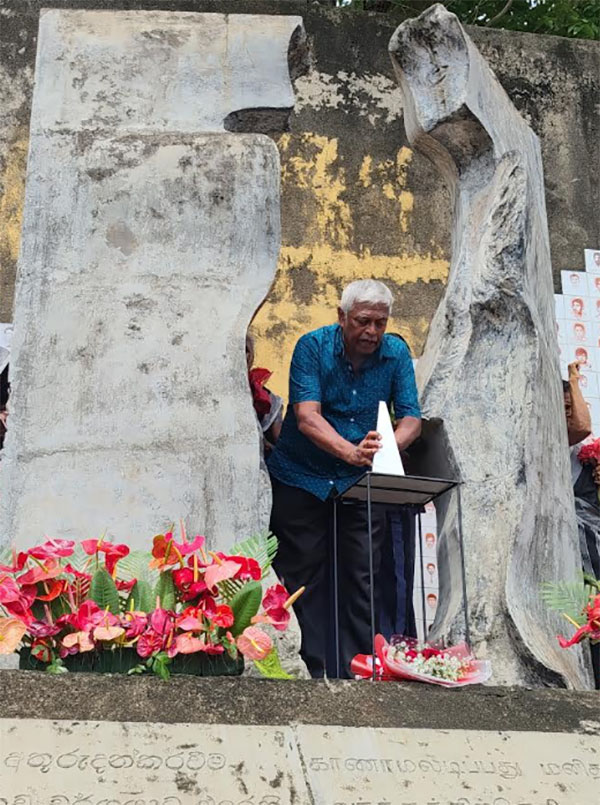
The collective struggle to seek justice for enforced disappearances in Sri Lanka is gaining massive international recognition. The prestigious Per Anger Prize, awarded by the Swedish government for human rights and democracy, was recently presented to Comrade Brito Fernando, the convener of the Families of the Disappeared. This award is not merely an ornament; it is a profound tribute recognizing the labour of individuals who have fought to change the blood-stained history of enforced disappearances in Sri Lanka.
Mr Brito Fernando’s political and social activism began in the Negombo area during the 1980s and 1990s. As an activist at the Negambo Periyamulla Church, he established a youth society and empowered local youth. He subsequently entered politics through the Nava Sama Samaja Party (NSSP) alongside Comrade Linus Jayatilake, and he also served as a councillor in the Negombo Municipal Council.
He commenced his direct intervention on behalf of the disappeared during the 1988–1989 reign of terror. Having gathered information through the NSSP’s Association of Parents and Children of the Disappeared, he was deeply affected by the incident in which two youths—Ranjith, the fiancé of Ms. Jayanthi Dandeniya, and his legal adviser, Lionel—were murdered and burned. Alongside Ms. Dandeniya and others, he took the lead in demanding justice for them. The Ranjith–Lionel commemoration programme, held on 27 October 1992, and the construction of the Raddolugama monument in 2000 marked the beginning of a new journey in the search for justice for the disappeared.
Standing as a close brother rather than a leader to the oppressed mothers, wives, and children, Comrade Brito founded the ‘Families of the Disappeared’ (FoD) in 2004. Today, it represents over 20,000 families, uniting families from the Sinhala, Tamil, and Muslim communities in a common struggle for truth and justice. He made an exceptional contribution to expanding this struggle, which had previously been confined exclusively to families in the South, across the Northern and Eastern Provinces as well.
In a struggle that has dragged on for over 35 years, he has never abandoned his cause, regardless of which government or ruler was in power. He could not be subjugated by money or power, nor could he be stopped by the police, the military, or mobs. He has been subjected to detention and arrest on several occasions for the sake of this struggle. Furthermore, he has faced interrogations under accusations of involvement in terrorism, as well as attacks on his home.
Transitional justice refers to the steps taken by a society regarding past large-scale human rights violations (disappearances, murders, etc.) to seek the truth, ensure accountability for the perpetrators, provide compensation to victims, and guarantee that such tragedies do not recur.
This award proclaims to the world that the forcibly disappeared in Sri Lanka absolutely deserve truth and justice, and that the state’s commitment to this end must be subjected to further intense scrutiny. At a time when hundreds of mothers in the North and East have been engaged in an unyielding struggle for their loved ones for over 3,000 days, it is extremely crucial to establish what happened to the disappeared and to secure accountability.
The Swedish government’s international Per Anger Prize for human rights and democracy was instituted in 2004. It is named after Per Anger, a heroic diplomat who served in Budapest during the Second World War and helped save Hungarian Jews from the Holocaust. The prize is awarded annually to exceptional individuals or organizations that make a humanitarian and democratic contribution to their home country. Previously, this prize has been awarded to numerous activists around the world who have fought fearlessly for human rights.
Presenting this prize, the jury stated in its declaration: ‘Without seeking personal gain or recognition, Brito Fernando bravely advocates for the voiceless. He works tirelessly demanding accountability and relief. Risking his own safety, he builds bridges between ethnic and religious groups in a country marked by deep divisions, while defending the idea of a society where justice applies to all.’ Therefore, the jury emphasized that this is a recognition of a lifelong commitment to the service of humanity.
‘The honour is not for me. This prize is for the families who fought without giving up for over 35 years’, says Comrade Brito, who is a true leader as well as a beloved brother who rejects bureaucracy. To lead this unwavering humanitarian struggle, which has been appreciated even internationally, to its final victory, we at the Right to Life Human Rights Centre wish Comrade Brito Fernando even more strength, courage, and good health!
Right to Life Human Rights Centre