
Right to Life Human Rights Centre
Three months have passed since Cyclone ‘Ditwa’ swept across Sri Lanka in late November. Although the focus of news headlines has shifted to other topics, the real struggle of the victims is not yet over. Ditwa was not merely a severe weather event, but a crucial moment that tested the resilience of our systems and institutions. This article analyzes the extent of the damage, the government’s response, and the actual reality experienced by the victims three months later.
History and Statistical Background of the Damage
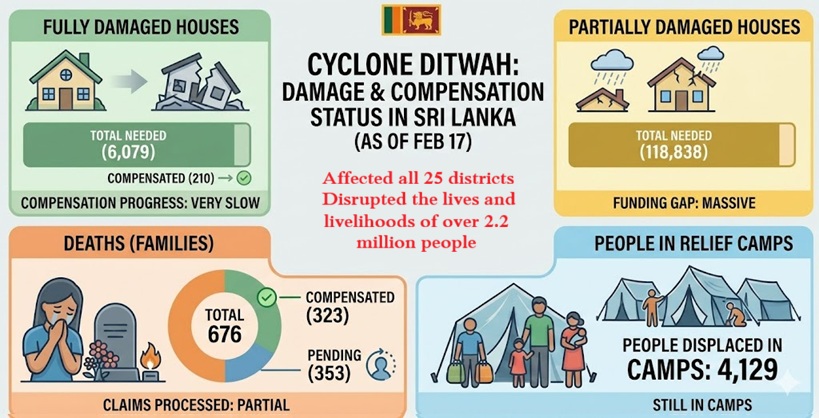
Cyclone Ditwa, the most severe climate disaster the country has faced in decades, affected all 25 districts and disrupted the lives and livelihoods of over 2.2 million people. Its impact was most severely felt by small-scale farmers and fishers, who serve as the backbone of the country’s food security.
Agricultural Damage: Over 129,000 hectares of agricultural land were inundated, affecting more than 227,000 farming families.
Crop Destruction: According to government statistics, 108,000 hectares of paddy cultivation, 11,000 hectares of other field crops, and 6,600 hectares of maize were completely destroyed.
Livestock and Fisheries Sectors: More than 37,000 cattle and buffaloes, nearly 16,000 goats and sheep, as well as 475,000 poultry were lost, while the Food and Agriculture Organization (FAO) estimated the damage to the fisheries sector to be around 70 million USD.
Food Insecurity: In the face of this situation, food security concerns have arisen for over 1.1 million people.
Government Actions for Recovery and the Reality of the ‘Rebuilding Sri Lanka’ Fund
To rebuild the country following the disaster, the government launched a national program and a fund named “Rebuilding Sri Lanka” on January 13th, headed by the President. By February 10th, Rs. 6.072 billion and USD 10.29 million had been collected in this fund.
However, according to inquiries made under the Right to Information (RTI) Act and facts revealed at the Parliamentary Committee on Public Finance, serious issues have emerged regarding the legality and transparency of this fund:
- Lack of a Legal Framework: ‘Action is still being taken’ to establish the fund at the Presidential Secretariat, and the relevant draft bill is still being prepared.
- Fund Management: All the collected funds are deposited in a Central Bank account under the Deputy Secretary to the Treasury, rather than in a legally established new fund.
- Limitations of the Management Committee: The appointed committee lacks direct authority to release funds, and their role is limited merely to public relations and strategic guidance.
Against the backdrop of an existing, legally established fund for such purposes under the Sri Lanka Disaster Management Act (operational since 2005), collecting money into a new fund without a formal legal framework raises suspicions regarding institutional procedures.
The Situation Three Months Later from the Victims’ Perspective
While policymakers discuss funds and committees, the reality for victims at the grassroots level is extremely harsh.
- Extreme Sluggishness in Providing Compensation: According to reports in the Lankadeepa newspaper, out of 6,079 fully damaged houses, compensation had been provided to only 210 by February 17th. Out of 118,838 partially damaged houses, only 3,095 have received funds. Compensation has been paid for only 323 out of 676 deaths, and 4,129 people are still living in relief camps.
- Livelihood and Liquidity Crisis: Post-disaster recovery is determined by the rapid establishment of financial liquidity. Failure to do so results in victims falling into long-term poverty. However, out of 1,384 individuals eligible for loss-of-livelihood compensation, 1,077 had not received those funds even as the three-month mark approached.
- Shortage of International Aid: As stated in a letter issued by the Food and Agriculture Organization of the United Nations (FAO) requesting 16.5 million USD in aid, only 400,000 USD had been received by that time (a funding gap of 97.6%). Although the government stated it would convene an international donor conference for post-disaster rebuilding, it did not materialize. As global attention has now shifted to other matters, it is no longer possible to hold it either.
- Agricultural Future at Risk: Due to the lack of urgent assistance or adequate government intervention, hundreds of thousands of families faced the risk of missing an entire cultivation season.
Conclusion
If Sri Lanka learns only one lesson from Cyclone Ditwa, it should be this: recovery spending alone does not create resilience.
From the perspective of the victims, they do not want the same old cycle. What they need is systemic change. They expect the collected funds to reach the victims promptly and transparently, early warnings to be translated into practical actions, and a mechanism where risk is shared fairly with the government and the market. The foremost need today is for the recovery process to become not merely a political project, but a victim-centric agenda that builds genuine resilience within them.
Policy Brief – https://www.right2lifelanka.org/climate-justice/