
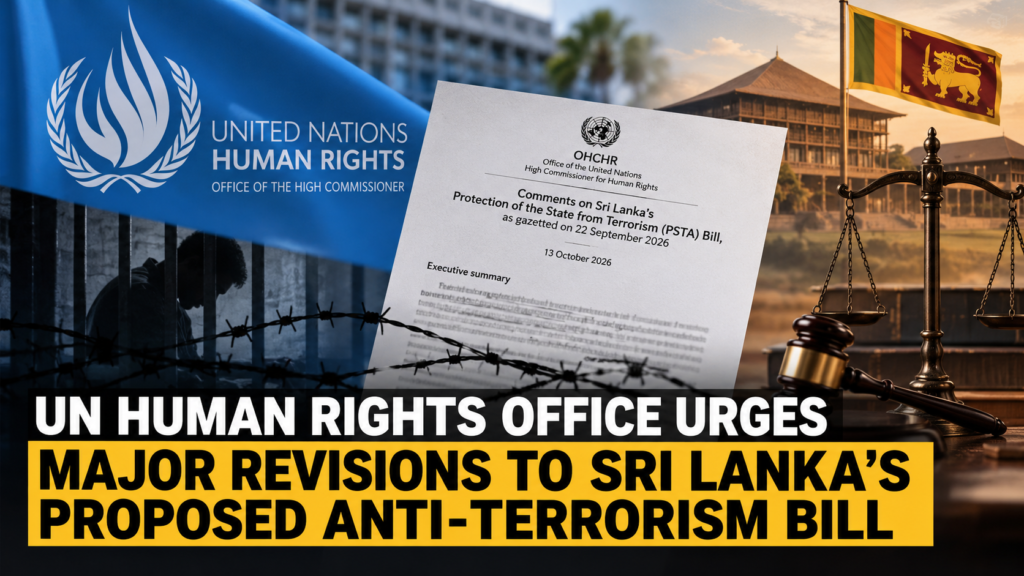
The United Nations Office of the High Commissioner for Human Rights (OHCHR) has called on the Sri Lankan Government to substantially revise the proposed Protection of the State from Terrorism (PSTA) Bill, warning that several provisions could perpetuate serious human rights violations associated with the existing Prevention of Terrorism Act (PTA).
In its preliminary observations dated 13 October 2026, the OHCHR examined the Bill gazetted on 22 September 2026 and expressed concerns over broad definitions of terrorism, prolonged detention without adequate judicial oversight, extensive executive powers, and insufficient safeguards against torture, arbitrary detention and enforced disappearance.
While acknowledging improvements over earlier drafts, including the removal of police confessions as admissible evidence, additional protections for journalists and civil society, and mandatory audio-visual recording of police interviews, the UN Human Rights Office warned that significant shortcomings remain.
A central concern is the continued use of executive detention orders. Under the proposed legislation, the Secretary to the Ministry of Defence could authorize detention for up to two months at a time, with detention potentially extending to one year. OHCHR emphasized that detention must be subject to prompt and effective independent judicial oversight, with courts empowered to review its legality and order release where appropriate.
The Office also raised concerns that broadly defined terrorism-related offences could be used to restrict freedom of expression, peaceful assembly, association and legitimate activities undertaken by journalists, human rights defenders and civil society organizations.
Furthermore, the proposed extension of arrest, search and detention powers to the armed forces and coast guard raises questions about civilian oversight, accountability and the protection of detainees from torture and ill-treatment.
OHCHR also cautioned that transitional provisions could allow existing PTA cases and restrictive measures to continue under the previous legal framework, potentially undermining the intended reforms.
Among its key recommendations, OHCHR called for narrower definitions of terrorism, stronger judicial safeguards, immediate and confidential access to legal counsel, effective protections against torture, independent accountability mechanisms and meaningful public consultation.
The Office stressed that repealing the PTA must result in substantive legal reform rather than the continuation of its problematic provisions under new legislation.
It urged the Government to undertake a comprehensive and transparent review of the Bill in consultation with civil society organizations, affected communities, legal professionals and independent institutions before proceeding with enactment.
Source: