
Sri Lanka’s unprecedented economic crisis in 2022 was not just a macroeconomic failure; it was a profound human tragedy that rapidly pushed the national poverty rate to 25%. For decades, the legacy Samurdhi system had served as a fragile safety net, delivering cash transfers to roughly 1.7 million beneficiaries out of a targeted two million. When the government announced the sweeping transition to the unified “Aswesuma” welfare program, hope mingled with deep anxiety, with the government estimating that as many as 3.9 million families could apply for the new welfare benefit scheme. No Aswesuma funds were disbursed during this volatile transitional year, leaving the most vulnerable populations exposed. At Right to Life (R2L), our ongoing grassroots research has continuously tracked how this deep-seated economic vulnerability intersects with systemic injustices, a reality comprehensively documented in the Right to Life Articles.
The shift toward the new registry required immense administrative endurance from a population already in distress. As macroeconomic challenges persisted into 2023, driving the World Bank’s estimated poverty rate to 25.9%, Phase I of Aswesuma finally launched. Field officers surveyed over 3.35 million families, officially certifying approximately 3.4 million units in the Welfare Benefit Information System. The state eventually deemed 1.9 million families eligible, successfully delivering vital cash transfers to 1.8 million households by year-end. However, as the national poverty rate showed a slight stabilization at 24.5% in 2024, severe administrative bottlenecks began to stall progress. Although a Phase II application window pushed the national registry past 3.12 million files, and Parliament structurally integrated legacy categorical benefits for the elderly, disabled, and chronic kidney disease patients into a legally expanded target of 2.4 million families, actual core family deliveries stagnated at 1.8 million due to verification delays.
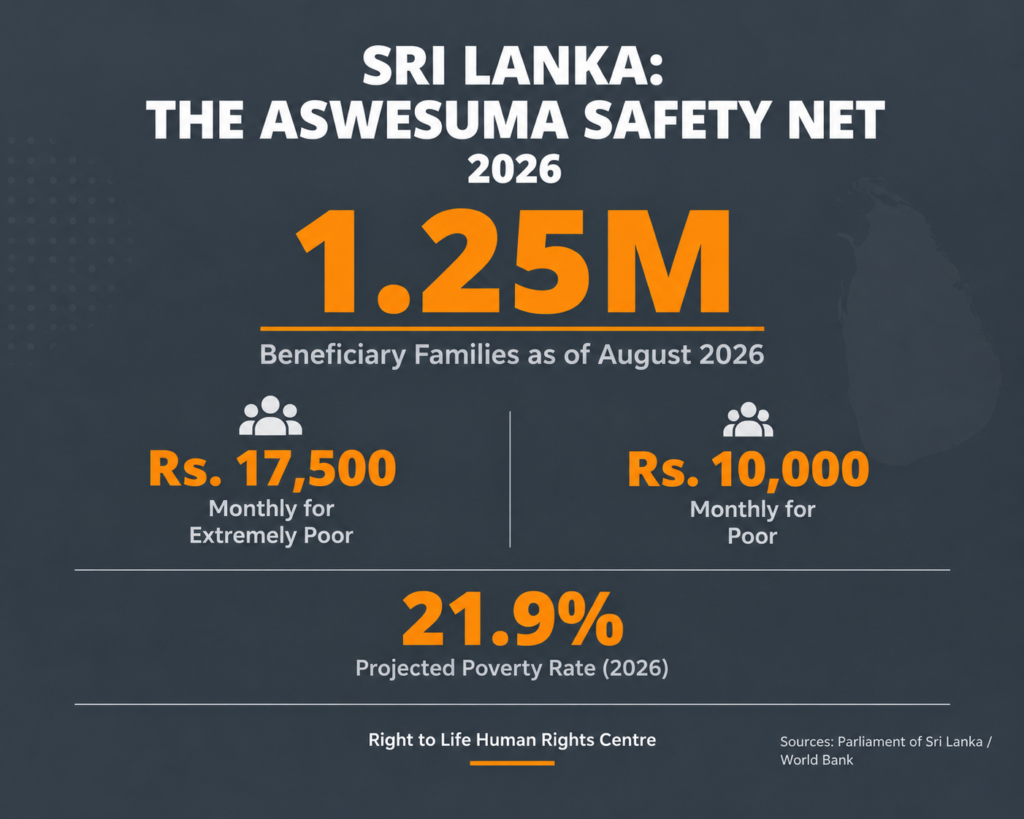
By 2025 and into 2026, the state’s approach shifted from broad expansion to rigorous consolidation and target reduction. Despite a modest economic recovery, poverty remained stubbornly above 21.9%. Mass application drives were halted in favor of a massive data recertification process, which triggered significant fluctuations in beneficiary rolls. In April 2025 alone, roughly 420,000 families lost their benefits as short-term relief brackets were phased out. Following a massive 90% completion of re-verifications by September 2026 and the scheduled expiration of the “transitional” and “vulnerable” categories, overall Aswesuma family deliveries dropped sharply to 1,251,522 by August 2026. The government has now narrowed its focus exclusively to the “Extremely Poor” and “Poor” categories, raising their monthly allowances to Rs. 17,500 and Rs. 10,000, respectively, while continuing categorical support such as the Rs. 3.48 billion allocated to nearly 696,612 elderly beneficiaries in the third quarter of 2026.
As a human rights and civil society collective, R2L recognizes that while Aswesuma’s targeted cash transfers are critical for immediate survival, they are only a temporary bandage for systemic disenfranchisement. Our past experiences in advocating for robust social security have repeatedly demonstrated that true community resilience requires pairing state welfare with active initiatives promoting micro-entrepreneurship. Providing marginalized communities with the skills and capital to build independent livelihoods is the only way to break the generational cycle of poverty. When families are perpetually trapped in economic despair, they become highly susceptible to overlapping crises; for instance, poverty and parental neglect are recognized as significant drivers of severe social issues like child sexual exploitation. A sustainable safety net must therefore go beyond algorithmic registries. By bridging Aswesuma’s financial relief with R2L’s micro-entrepreneurship programs and combining this with the legal advocacy detailed in the Right to Life Articles, we can ensure that Sri Lanka’s most vulnerable citizens are not merely surviving on state aid, but are actively empowered to thrive.